Three words, when interwoven, become a haunting reflection of civilization’s wounds: Palestine, genocide, and ecocide. These are not mere academic terms or political jargon, but harsh realities that are screaming before us today. Palestine is a land steeped in history, illuminated by revelation, and filled with the prayers of the faithful. Yet, it remains a stage for unrelenting suffering. It is here that genocide finds its naked face, accompanied by ecocide—a silent murder of the earth and everything living upon it.
A Symbol of Colonialism’s Enduring Scar
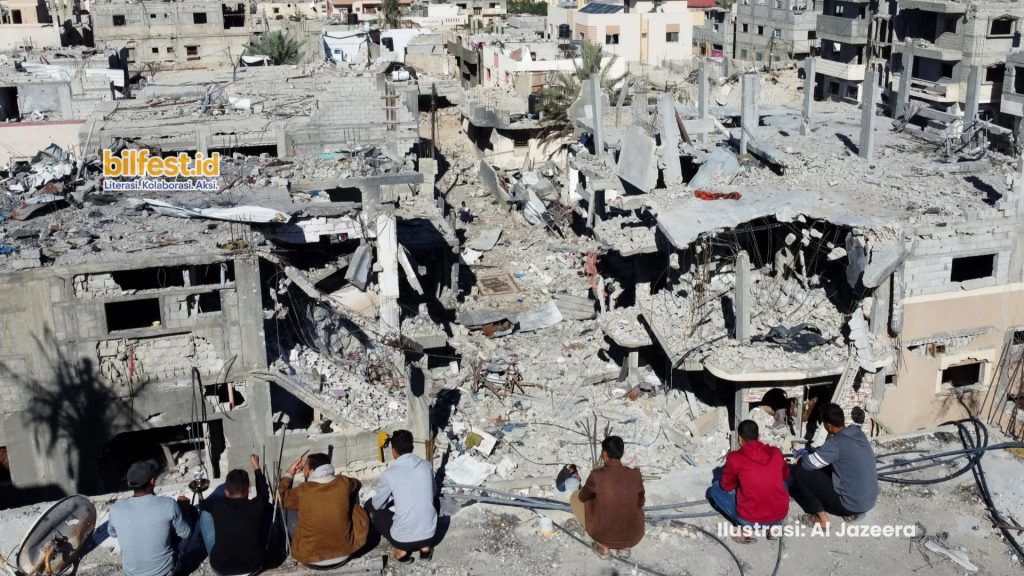
Since the early 20th century, Palestine has been more than just a geopolitical issue; it has become a powerful symbol of humanity’s struggle against injustice. In this land, homes are reduced to rubble by bombs, mosques and churches crumble, schools turn to dust, and children are robbed of their future. The world watches with open eyes as a nation fights simply to survive on its own ancestral land.
The 1948 Nakba (Catastrophe), when hundreds of thousands of Palestinians were expelled from their homes, is not just a historical footnote. It was the genesis of a modern colonialism that continues to this day. Palestine teaches the world that colonialism is not dead. It has merely changed its guise, becoming more modern, more systematic, and more deliberate in its execution.
Genocide: The Wound on Humanity
The word “genocide” can no longer be avoided when discussing the tragedy unfolding in Palestine. According to the 1948 UN Genocide Convention, genocide is defined as acts committed with the intent to destroy, in whole or in part, a national, ethnical, racial, or religious group. If this standard is applied, what is happening in Gaza and the West Bank today has clearly exceeded the requirements of that definition.
The genocide in Palestine is manifest: the mass killing of civilians; the intentional starvation created through blockades; the forced displacement that severs generations from their ancestral land; and the systematic destruction of vital infrastructure—hospitals, schools, and places of worship. What is being annihilated is not just human bodies, but the collective hope of a nation to endure.
A profound question arises: How long is the world willing to turn a blind eye to this suffering that is occurring in plain sight? In an era that prides itself on universal humanitarian values, the Palestinian genocide stands as a global irony.
Ecocide: The Silent, Deeper Injury
However, genocide does not walk alone. It is accompanied by ecocide, the murder of the Palestinian earth. If genocide targets the human, ecocide strikes at the very living space that sustains humanity.
Once green farmlands are now scorched. Olive trees, icons of the Palestinian economy and culture, are forcibly uprooted as if to erase historical footprints and identity. Rivers and water sources are controlled, leaving the Palestinian people in a severe water crisis. The use of white phosphorus bombs in the conflict not only kills human bodies but also poisons the land and air. The sea around Gaza is polluted, while war debris destroys biodiversity.
Ecocide in Palestine reveals the face of modern warfare: it is not just about blood and bullets but about ecological devastation that leaves a long-lasting wound for future generations. Human life and the ecosystem are being erased simultaneously.
The Twin Wounds Converge
This is where Palestine becomes a dual symbol: genocide and ecocide are walking hand-in-hand, mutually reinforcing the destruction of life. The killing of people occurs concurrently with the killing of the ecosystem. The Palestinian people are not only losing their land and their right to self-determination but also a viable living space for their descendants.
This tragedy confirms that modern crimes no longer recognize a boundary between the human body and the body of the earth. Both are being victimized equally. Palestine is a testament to how broken the world becomes when power and ideology override the values of humanity and ecological preservation.
A Mirror for Civilization
As human beings, we are invited to look into the mirror: Will the suffering in Palestine merely become fleeting daily news? Or will we internalize it as a moral calling to uphold both humanity and the protection of the earth?
Palestine today is essentially a metaphor for the future of our civilization. If the world allows genocide and ecocide to continue unchecked, we are bequeathing a future generation a world with a dull conscience and a shattered ecosystem.
Therefore, talking about Palestine is not just about political conflict. It is a moral gamble for mankind. It is a test for the global conscience: are we still capable of protecting the dignity of our fellow human beings while also caring for the earth as our shared home?
Palestine, genocide, and ecocide are not three separate words. They are a single chain of civilizational wounds that demands the moral accountability of humanity. And it is here that we are tested: will we let the wound gape open, or will we dare to stitch it closed with courage, solidarity, and humanism?

Alvin Qodri Lazuardy, sedang berproses menjadi pendidik, penulis, dan penggerak literasi Islam-lingkungan. Ia berfokus pada kajian worldview Islam, filsafat pendidikan Islam, ekoliterasi, dan kepesantren. Aktif menulis di bilfest.id, suaramuhammadiyah.com, pwmjateng.com, Ibtimes.id serta mengelola Alfuwisdom Publishing di Yogyakarta.